
Vacuon

Disk space analyzer for Windows. Reads the NTFS MFT straight off the volume, shows the real content of what you are about to delete, and never claims a number it did not measure.

⬇ Download for Windows Source on GitHub

Portable, 62 MB, nothing to install — it runs from a USB stick.

# or, from a terminal
winget install Joedsonalves.Vacuon
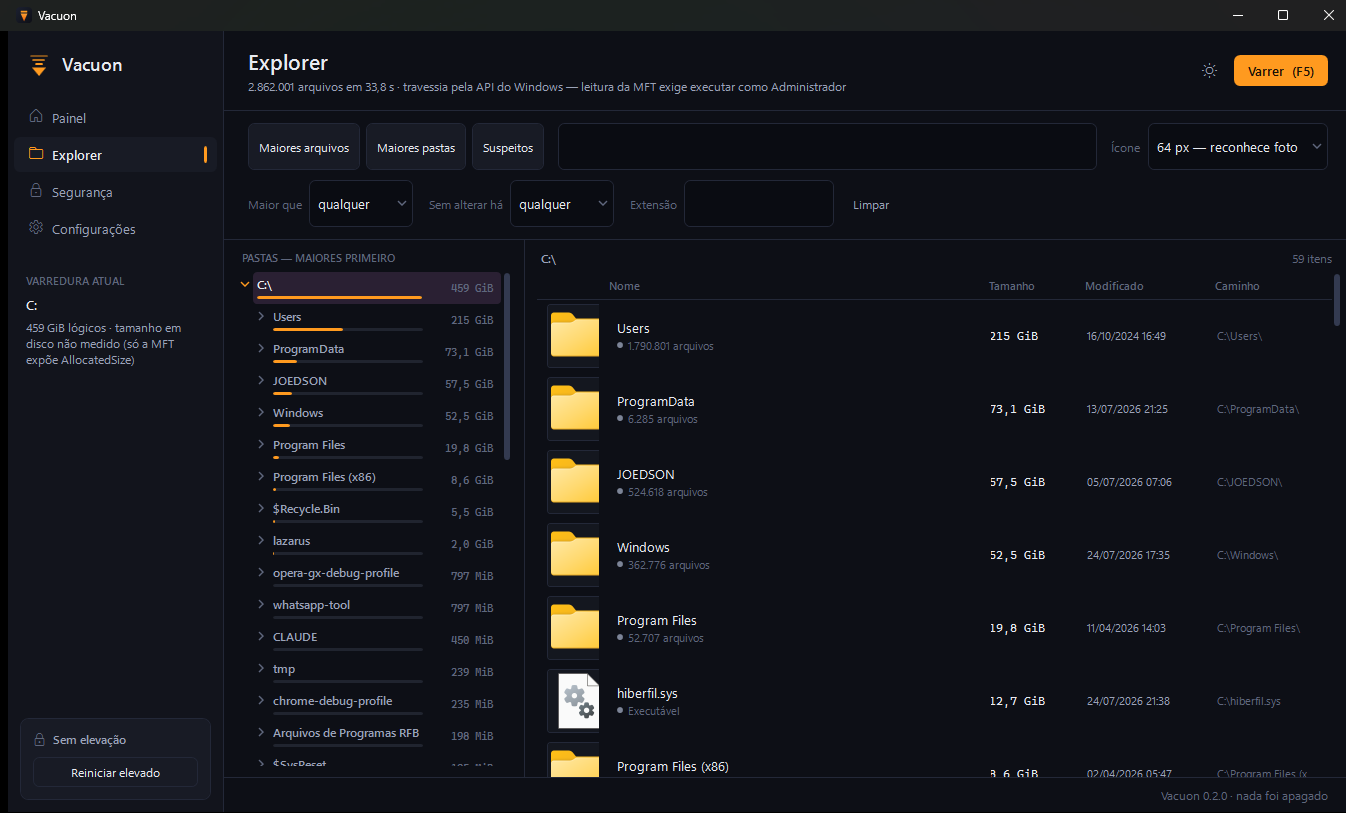
Vacuon showing the folder tree beside the file list, with sizes and thumbnails

The Explorer: the folder tree, the files inside it, and a thumbnail of what each one actually is.

What it does

Finds where the space went

Reading the Master File Table directly indexed 2.34 million files in 11.5 seconds on the machine it was built on. Without Administrator it still works, through the slower Windows API — and says which path it used.

Shows what it is before you delete it

Thumbnails of the real content in six sizes, media details, and a preview panel — so you can tell which of five large renders is the final one without opening any of them.

Duplicates, look-alikes and a treemap

Identical files by hash, pictures that merely resemble each other by fingerprint, and the whole volume drawn as boxes sized by what they occupy.

Cleans by rule, and reversibly

A rule catalogue that calls Microsoft's own tools where the work belongs inside Windows, a quarantine it can restore from, and a live monitor reading the NTFS change journal.

The rule the whole app is built on

Vacuon never states a number it did not measure. That is not a slogan — version 0.3.0 reported Size on disk 758 GiB on a 476 GiB volume, one line above the correct 377 GiB used of 476 GiB, and nothing complained, because nothing compared the two. Every scan now cross-checks the space it attributed to files against what the volume reports as used, and says so when the two disagree.

Before you download

Windows will warn you, and that is expected. The file is not code-signed, so the first run shows a blue “Windows protected your PC” screen: click More info, then Run anyway. If you would rather not trust an unsigned binary from a stranger, that is the correct instinct — the source builds in three commands, and the SHA256 of every published file is in the release notes.